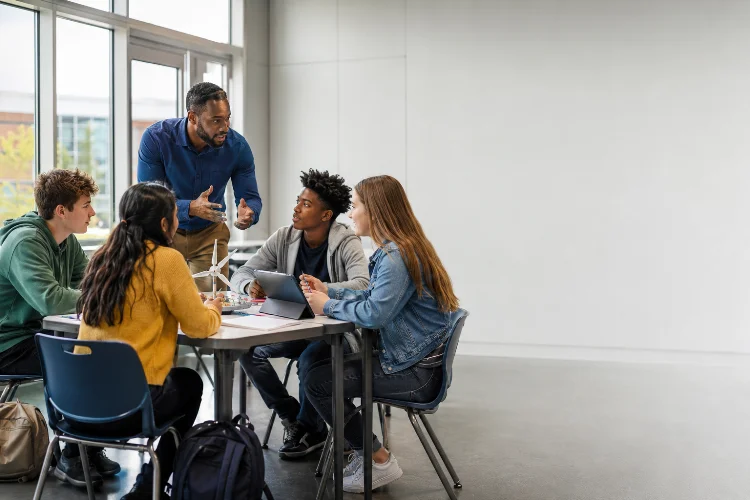
A classroom can look perfectly organized while very little learning is actually happening. Students may sit quietly, copy notes, listen to explanations, and complete worksheets, yet still struggle to explain the lesson when class is over.
That is why good teaching involves more than presenting information clearly. Students also need opportunities to question ideas, solve problems, explain their thinking, discuss concepts, make decisions, and connect new knowledge with what they already understand.
Using effective teaching methods that encourage students to learn actively can transform students from passive listeners into participants in the learning process.
Active learning does not mean teachers must remove lectures completely or turn every lesson into a complicated group project. Instead, it means designing moments where students must mentally work with the material.
A major meta-analysis of 225 undergraduate STEM studies found that active-learning classes produced higher examination performance and lower failure rates than traditional lecture-based classes.
The challenge is choosing methods that create meaningful participation rather than activity for its own sake.
Understand What Active Learning Actually Means
Active learning is sometimes misunderstood as simply keeping students busy.
A classroom can contain plenty of movement and conversation without much meaningful thinking.
The real goal is cognitive engagement.
The ICAP framework developed by Michelene Chi and Ruth Wylie describes learning activities across passive, active, constructive, and interactive forms of engagement.
Their framework proposes that deeper forms of cognitive participation can generally create stronger opportunities for learning.
For example, listening to a teacher explain a concept is relatively passive. Highlighting important information requires some activity.
Explaining the concept in your own words becomes constructive.
Discussing different explanations with another student can become interactive.
Teachers do not need to eliminate direct instruction. A short explanation may be exactly what students need before attempting a more challenging activity.
The key is avoiding lessons where students spend almost the entire class receiving information without using it.
Ask Questions That Require Students to Think
Questions are among the simplest active-learning tools available.
However, the quality of the question matters.
“What year did this event happen?” may test memory.
“Why do you think this event happened?” requires explanation.
“What might have happened if one condition had been different?” requires students to analyze possibilities.
Instead of asking a question and immediately calling on the fastest student, give everyone time to think.
A teacher might ask:
“What evidence supports this conclusion?”
Students first write an answer individually for one minute. They then compare ideas with a partner before the class discusses the question together.
This simple structure gives quieter students time to formulate their thoughts and prevents a small number of confident students from dominating every conversation.
It also changes questioning from a teacher-student exchange into a learning task for the whole room.
Use Think-Pair-Share for Low-Pressure Participation
Not every student enjoys speaking immediately in front of an entire class.
Think-Pair-Share creates a softer entry point.
The process is simple.
First, students think about a question individually.
Next, they discuss their answer with a pair.
Finally, students share their conclusions with a larger group or the class.
Imagine a literature teacher asking:
“Why does the main character refuse the offer in this scene?”
Instead of immediately requesting volunteers, students get two minutes to develop an interpretation and find supporting evidence.
Pair discussion allows them to test their reasoning before speaking publicly.
The technique can be used in mathematics, history, science, business, languages, and many other subjects.
It is also easy to use without special technology or complicated preparation.
The important part is choosing a question that actually deserves discussion.
Turn Students Into Teachers With Peer Instruction
One powerful way to learn something is to explain it to somebody else.
Peer instruction uses this idea by asking students to consider a conceptual question, commit to an answer, discuss their reasoning with classmates, and then reconsider the question.
Research by Catherine Crouch and Eric Mazur reported improved conceptual reasoning and quantitative problem-solving performance after Peer Instruction was introduced in introductory physics courses.
For example, a science teacher might present a multiple-choice question about forces.
Students choose an answer individually.
Instead of immediately revealing the correct option, the teacher asks students with different answers to explain their reasoning to each other.
Suddenly, students must defend their ideas.
They are no longer asking only, “Which answer is correct?”
They are asking, “Why do I believe this answer is correct?”
That change encourages deeper thinking.
Peer explanation can also help teachers notice misconceptions that would remain invisible during a normal lecture.
Use Problems and Real Situations to Make Learning Relevant
Students often become more engaged when knowledge has a clear purpose.
Problem-based learning introduces students to a meaningful problem and requires them to use knowledge, research, reasoning, and collaboration to develop possible solutions.
A business class might ask students to design a strategy for a struggling local café.
Environmental science students might investigate ways to reduce waste on campus.
Mathematics students could compare different loan options and calculate long-term costs.
A 2025 second-order meta-analysis combining findings from 22 previous meta-analyses reported an overall positive effect of problem-based learning on cognitive and affective learning outcomes, although the size of the effect varied with research quality and other factors.
The problem should still match the students’ level.
Giving beginners an extremely complex challenge without enough background knowledge can create confusion rather than productive struggle.
Teachers can provide scaffolding through examples, guiding questions, mini-lessons, or structured resources.
The goal is not to remove support. It is to gradually transfer more thinking responsibility to students.
Build Short Retrieval Activities Into Every Lesson
Active learning does not always require group activities.
Sometimes the most effective activity is simply asking students to remember something without looking at their notes.
At the beginning of class, teachers can ask students to spend three minutes writing everything they remember from the previous lesson.
At the end, students might answer two questions about the day’s most important concepts.
These small exercises use retrieval practice.
Rather than repeatedly exposing students to information, retrieval requires them to produce knowledge from memory.
A teacher discussing photosynthesis, for instance, might stop after an explanation and ask:
“Without checking your notes, write the main inputs and outputs of photosynthesis.”
Students then compare their answers with the correct explanation.
This immediately reveals what they understood and what needs clarification.
Frequent low-stakes retrieval can also make assessment feel less threatening because students become accustomed to checking their knowledge regularly rather than encountering questions only during major exams.
Encourage Discussion Without Letting It Become Random Conversation
Class discussion can encourage active learning, but simply saying “discuss this with your group” does not guarantee useful conversation.
Students need a clear intellectual task.
Instead of asking:
“Talk about climate change,”
ask:
“Which of these three policies would most effectively reduce urban emissions, and what evidence supports your choice?”
The second prompt provides direction.
Teachers can also assign temporary roles such as summarizer, evidence checker, questioner, or presenter when groups need more structure.
Collaborative learning works best when students have something meaningful to contribute and some individual responsibility.
Teachers should also move around the room and listen.
This is not only classroom management.
Student conversations provide valuable information about misconceptions, uncertainty, and reasoning.
If several groups are making the same mistake, the teacher can pause the activity and address it immediately.
That kind of responsive teaching is difficult when the teacher is doing all the talking.
Give Feedback While Students Can Still Use It
Feedback has the greatest practical value when students have an opportunity to act on it.
Imagine a student receives detailed comments on an essay after the course has already moved to a completely different task.
The feedback may still be useful, but its immediate impact is limited.
A more active approach creates a feedback cycle.
Students attempt something, receive guidance, revise their work, and try again.
For example, students might write a short thesis statement during class.
The teacher or a peer provides one specific suggestion.
Students then rewrite the statement immediately.
The learning happens partly through revision.
Feedback should also focus on the work rather than simply giving general praise.
“Great job” feels positive but provides little direction.
“Your argument is clear, but the second example does not directly support your claim” gives the student something concrete to improve.
Mistakes should be treated as information.
A classroom where students are afraid to be wrong will rarely become a genuinely active classroom.
Let Students Produce Something With Their Knowledge
Students understand material differently when they must create something from it.
After a lesson, ask them to build a concept map, write a short explanation, create an example, compare two theories, solve a new problem, or design a possible solution.
These activities require students to reorganize information rather than simply repeat it.
The ICAP framework particularly emphasizes the value of constructive activities where learners generate outputs that go beyond what was directly provided.
For example, after learning about ecosystems, students could design a simple food web for an imaginary island.
They would need to decide which organisms are producers, consumers, and predators and explain how changes to one population could affect others.
The activity looks simple, but students must combine several ideas.
Teachers can quickly see whether students understand relationships between concepts rather than only memorizing definitions seperately.
Explain Why Active Learning May Feel More Difficult
Active lessons can sometimes make students feel less comfortable than polished lectures.
During a good lecture, information may seem clear because the expert teacher has already organized the reasoning.
During active learning, students must do more of that mental work themselves.
Interestingly, a controlled study published in PNAS found that students in active-learning physics classes learned more while reporting a lower feeling of learning than students receiving passive instruction.
Researchers linked part of this difference to the greater cognitive effort required by active learning.
Teachers can explain this directly.
Tell students that struggling with a challenging question does not automatically mean the lesson is failing.
Productive difficulty is often part of learning.
Of course, difficulty should not become unnecessary confusion.
Teachers still need to provide explanations, examples, guidance, and checkpoints.
A succesful active-learning classroom balances challenge with support.
Combine Active Learning With Clear Direct Instruction
Active learning and teacher explanation should not be treated as enemies.
Sometimes students need someone knowledgeable to clearly introduce a concept.
A teacher might explain a new idea for ten minutes, demonstrate an example, and then ask students to apply the idea to a new problem.
After checking their responses, the teacher can provide clarification before moving into discussion or practice.
A review of active-learning research by Michael Prince found broad, although uneven, support for active, collaborative, cooperative, and problem-based learning approaches.
The lesson is not that every lecture is bad.
The issue is relying on passive listening as the primary learning experience.
Good teaching uses explanation strategically and then gives students opportunities to do something intellectually meaningful with that explanation.
That combination is often more practical than trying to make every minute of class interactive.
Start Small and Improve the Method Over Time
Teachers do not need to redesign an entire course overnight.
Start with one lesson.
Replace ten minutes of explanation with a challenging question.
Add a two-minute retrieval exercise at the beginning of class.
Let students explain one problem to a partner.
Ask them to summarize the most important idea before leaving.
Then observe what happens.
Which students participated?
Where did they struggle?
Did the activity reveal misconceptions?
Was the question too easy or too difficult?
Active teaching becomes better through the same process we want students to use: attempt, feedback, reflection, and improvement.
Methods should also be adapted to the students, subject, age group, class size, and learning objectives rather than copied consistantly without considering context.
Effective teaching is not measured by how much information a teacher can deliver during one lesson. What matters is what students understand, remember, discuss, apply, and eventually use independently.
Active-learning methods such as purposeful questioning, Think-Pair-Share, peer instruction, retrieval practice, problem-based learning, structured discussion, and immediate feedback can give students a more meaningful role in the learning process.
Research also suggests that active learning can improve academic outcomes when it is thoughtfully implemented.
Teachers do not need to use every strategy at once. Choose one upcoming lesson and add a moment where students must explain, retrieve, solve, compare, or create something. Observe their responses and adjust the next lesson.
Small changes made occassionally at first-and more deliberately over time-can gradually create a classroom where students do not simply receive knowledge but actively learn how to use it.