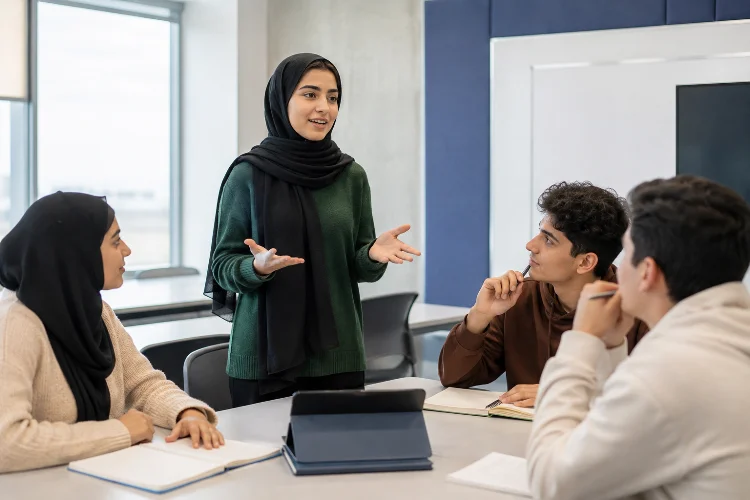
A student can understand a subject extremely well and still struggle academically if they cannot explain what they know.
They may have great ideas but write confusing essays, stay silent when they need clarification, or find it difficult to contribute during group projects.
That is why communication is such an important academic skill.
Developing communication skills every student needs for academic success is not simply about becoming confident enough to speak in front of a classroom.
Communication includes listening carefully, asking useful questions, organizing ideas, writing clearly, participating in discussions, presenting information, collaborating with classmates, and communicating professionally online.
These abilities influence how students interact with teachers, understand instructions, complete assignments, and demonstrate what they have learned.
Carnegie Mellon University even includes communication and presentation among the core competencies it considers foundational to students’ academic and professional development.
The good news is that communication is not a fixed personality trait. Like writing or mathematics, it improves through deliberate practice.
Learn to Listen Before Trying to Respond
Good communication begins with listening.
Students sometimes appear to listen while actually preparing their own response, checking a device, or thinking about something completely unrelated.
Active listening is different.
It involves paying attention to what someone is saying, identifying the main point, noticing areas of confusion, and responding appropriately.
Carnegie Mellon describes active listening as a way to better understand another person’s questions, concerns, and needs. Useful techniques include paraphrasing what was said and asking probing questions that deepen the conversation.
Imagine a teacher explains a complicated assignment.
Instead of immediately asking, “When is it due?” listen for the objective, required format, sources, grading criteria, and deadline.
If something remains unclear, summarize your understanding:
“So we need to compare two theories, use at least three academic sources, and explain which theory is stronger. Is that correct?”
That short clarification can prevent major mistakes later.
Ask Questions Without Being Afraid to Look Confused
Students sometimes avoid asking questions because they worry that everyone else already understands.
Usually, someone else is confused too.
Good questions can improve understanding quickly.
Instead of saying:
“I don’t get this.”
Try identifying the exact problem:
“I understand the first step of the equation, but why does the negative sign disappear in the second step?”
That gives the teacher something specific to explain.
Questions can also move beyond clarification.
Students can ask:
“What evidence supports this argument?”
“How does this connect with the previous chapter?”
“Could you give another example?”
“What would happen if this condition changed?”
Asking questions is not evidence that you failed to learn.
Often, it shows that you are thinking carefully enough to notice where your understanding stops.
Speak Clearly During Classroom Discussions
You do not need to be the loudest person in the classroom to communicate effectively.
Clear contributions usually matter more than frequent ones.
When participating in a discussion, begin with your main idea and then support it.
For example:
“I think the policy could reduce traffic because it gives commuters a cheaper alternative to driving.”
That is easier to follow than speaking for several minutes before reaching your point.
A recent study involving 720 university students found a strong association between conversational skills and broader communication competence, although the researchers cautioned that the study was cross-sectional and did not prove causation.
Students can strengthen conversational ability through regular participation.
Start small.
Answer one question in class.
Explain one idea during group work.
Ask a classmate what they think.
Communication confidence often develops after participation, not before it.
Improve Academic Writing by Focusing on Clarity
Writing is communication on paper or screen.
An essay can contain excellent research and still be difficult to understand if the ideas are poorly organized.
Strong academic writing usually begins with a clear purpose.
Before writing a paragraph, ask:
“What is the main idea I want the reader to understand?”
Then support that idea with explanation, evidence, or examples.
Avoid adding complicated vocabulary simply to sound academic.
A simple sentence that communicates an idea accurately is more valuable than an impressive sentence nobody can understand.
Students should also separate drafting from editing.
Write the main ideas first.
Then return to improve structure, grammar, transitions, evidence, and wording.
Reading your work aloud can reveal awkward sentences that look perfectly normal on screen.
Clear writing is not about making every sentence short. It is about making the relationship between ideas easy for the reader to follow.
Develop Strong Presentation Skills
Presentations combine several communication abilities at once.
Students need to organize information, explain it clearly, control their timing, use visual material appropriately, and respond to questions.
Cornell University’s Center for Teaching Innovation notes that student presentations can help learners develop communication skills relevant to both academic and future professional settings.
It also recommends practice opportunities and feedback before final presentations.
Start by simplifying your message.
If you have ten minutes, you probably cannot explain twenty major ideas properly.
Choose the most important points.
Then organize them logically:
What should the audience understand first?
What information comes next?
What should they remember at the end?
Practice out loud instead of only reading your slides silently.
The first time you hear your own presentation should not be when you are standing in front of the class.
Use Slides as Support, Not a Script
A slide covered with paragraphs encourages students to turn around and read instead of communicate.
Use visuals, short phrases, diagrams, examples, or key data where appropriate.
Then explain the meaning in your own words.
Harvard’s ABLConnect similarly describes presentations as opportunities for students to practise communication, synthesize course content, strengthen recall, and build confidence.
The presenter should communicate the idea.
The slide should support it.
Learn How to Communicate During Group Work
Group projects test communication in a different way.
Students need to listen, negotiate, divide responsibilities, give feedback, resolve disagreement, and keep everyone informed.
Cornell notes that collaborative learning can help students develop communication and leadership skills while also exposing them to different perspectives and helping them clarify their understanding.
Good group communication starts with clear expectations.
Who is responsible for each task?
When are the internal deadlines?
Where will files be stored?
How quickly should members respond to messages?
What happens if someone cannot finish their section?
These questions may sound overly organized at first, but unclear communication causes many group-project problems.
Students should also learn to disagree without becoming personal.
Instead of:
“Your idea is bad.”
Try:
“I think option two might work better because it addresses the cost problem. Could we compare both approaches?”
You can challenge an idea without attacking the person who suggested it.
Practise Giving and Receiving Feedback
Feedback is another important form of academic communication.
Students often either make feedback too vague or too harsh.
“Looks good” does not provide much help.
“This makes no sense” is not particularly useful either.
Strong feedback identifies something specific.
For example:
“Your introduction explains the topic clearly, but I could not identify your main argument until the third paragraph.”
Now the writer knows exactly what to reconsider.
Receiving feedback is equally important.
Try not to treat every suggestion as criticism of your ability.
Listen first.
Ask questions if the comment is unclear.
Then decide whether making the suggested change would strengthen the work.
Cornell recommends helping student teams establish expectations for constructive feedback, respectful interaction, communication, accountability, and conflict management.
Feedback becomes much more usefull when both sides see it as information rather than judgment.
Learn Professional Digital Communication
Students communicate academically through email, learning platforms, discussion boards, shared documents, video calls, and group chats.
The style used with close friends may not always work in those environments.
A message to a teacher should usually be clear enough that they immediately understand why you are contacting them.
Instead of:
“Hi, what about assignment?”
try:
“Hi Professor Lee, I’m working on the research assignment due Friday and wanted to clarify whether the three required sources must all be peer-reviewed.”
The second message saves time for everyone.
The University of South Carolina describes online netiquette as communicating respectfully and professionally across discussions, email, video meetings, group work, and other course activities.
It also recommends reviewing messages before posting because tone can be difficult to interpret online.
Students should pay attention to tone, response time, clarity, and context.
Sarcasm can easily be misunderstood in text.
A ten-second reread before pressing “send” can prevent an unnecessary conflict.
Pay Attention to Nonverbal Communication
Not everything is communicated through words.
Eye contact, facial expressions, posture, tone of voice, pauses, and body language can influence how messages are interpreted.
Imagine presenting an excellent argument while looking at the floor and speaking so quietly that nobody can hear.
The content may be strong, but the communication is weaker.
Students do not need perfect body language.
Aim for basic awareness.
Face the people you are speaking with.
Use an audible voice.
Avoid constantly looking at your phone while someone else is talking.
Notice whether your tone sounds irritated when you actually intend to sound curious.
Nonverbal awareness becomes especially important during presentations, interviews, discussions, and teamwork.
Adapt Your Communication to the Situation
Strong communicators do not speak or write exactly the same way in every situation.
A text to a friend is different from an email to a professor.
A classroom presentation is different from a casual group discussion.
An academic essay requires a different style from a social media caption.
The audience matters.
Before communicating, ask:
Who am I speaking to?
What do they already know?
What do they need from me?
How formal should this be?
What is the purpose of the message?
A student explaining photosynthesis to a classmate might use everyday examples.
The same student writing a laboratory report may need precise scientific terminology.
Neither style is automatically better.
Effective communication means choosing the style that fits the purpose.
Become Comfortable With Difficult Conversations
Academic communication is not always pleasant.
Sometimes you need to tell a teammate they missed a deadline.
You may need to ask a teacher about feedback you disagree with.
Perhaps a classmate misunderstands something you said.
Avoiding every uncomfortable conversation usually makes problems worse.
Focus on the specific issue.
Instead of:
“You never do your work.”
say:
“We agreed to finish our sections by Tuesday, and your section is still missing. When can you complete it?”
Carnegie Mellon offers student training specifically focused on communication during team difficulties, including responding to poor-quality work, disagreement, and challenging interpersonal situations.
Calm, specific communication gives people something they can actually respond to.
Practise Communication Instead of Waiting to Become Naturally Good at It
Communication improves through use.
You cannot become a confident presenter only by reading about presentations.
You need to present.
You cannot become better at academic discussion without occasionally joining discussions.
You cannot improve writing without writing and revising.
Carnegie Mellon treats communication and presentation as competencies students can intentionally develop alongside collaboration, information literacy, and other foundational abilities.
Choose one small communication goal each week.
Ask one question during class.
Visit a teacher during office hours.
Volunteer to present part of a group project.
Rewrite one unclear email before sending it.
Listen to someone without interrupting.
Small repetitions make communication feel more natural over time.
The goal is not to become extremely outgoing.
Quiet students can be excellent communicators.
The goal is to make your ideas understandable and to understand other people’s ideas accurately.
Communication skills support almost every part of academic life.
Students need to listen carefully, ask useful questions, explain ideas clearly, write effectively, participate in discussions, collaborate with classmates, present information, and communicate professionally online.
These abilities are not reserved for naturally confident or extroverted students. They develop through repeated practice.
Start with one area that currently feels difficult. If presentations make you nervous, practise explaining one topic aloud for three minutes.
If group projects are frustrating, establish clearer communication rules. If writing feels confusing, focus on making the main idea of each paragraph obvious.
Academic knowledge becomes much more valuable when students can communicate it clearly. Practising these skills consistantly can help students not only perform better at school but also prepare for university, teamwork, interviews, and future professional life.