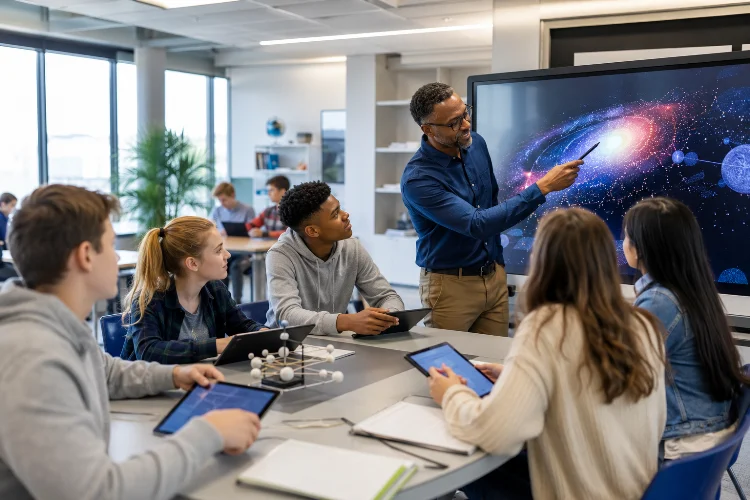
Walk into a modern classroom and you may see something very different from the traditional image of students quietly copying notes from a chalkboard.
Interactive displays, learning platforms, tablets, digital quizzes, artificial intelligence, simulations, and collaborative online tools are becoming increasingly common.
But educational technology is not simply about replacing paper with screens.
The bigger change is how technology can reshape the relationship between teachers, students, content, and assessment.
Used thoughtfully, digital tools can give students more opportunities to practise, receive feedback, collaborate, access different forms of content, and learn at a pace that better matches their needs.
Understanding how educational technology is changing modern classroom learning also requires some caution. Technology does not automatically improve education just because it is new.
UNESCO’s Global Education Monitoring Report notes that digital technology can support instruction and engagement, while research generally finds small to medium positive effects compared with traditional instruction-but results depend heavily on how technology is used.
The real question is therefore not whether classrooms should use technology, but how they can use it to make learning genuinely better.
Technology Is Making Learning More Interactive
Traditional classroom instruction often follows a simple pattern: the teacher explains something, students listen, and everyone completes an activity afterward.
Technology can make that process more interactive.
A science teacher, for example, can use a digital simulation to let students change variables and observe what happens. Instead of only reading about electrical circuits, students can virtually build one and immediately see how changing resistance affects current.
History students can explore digital archives.
Geography students can examine interactive maps.
Language learners can practise pronunciation using audio tools.
Digital technology can also increase the amount and variety of practice available to students. The Education Endowment Foundation notes that technology can support learning when it increases the quality or quantity of practice and helps teachers use assessment more effectively.
The key is interaction with a learning purpose.
Adding animation, videos, and games to a lesson may make it visually impressive, but those features matter only if they help students think about the subject.
Adaptive Learning Can Provide More Personalized Practice
Students rarely learn at exactly the same speed.
One student may understand fractions after two examples, while another may need ten examples and additional explanation.
Educational technology can make this difference easier to manage.
Adaptive learning platforms can adjust questions, difficulty, or support based on student responses. A learner who answers correctly may move to more challenging material, while someone who struggles may receive additional practice.
This does not mean an algorithm should decide everything a student learns.
Instead, adaptive tools can provide additional information that helps teachers identify patterns.
For example, a mathematics platform might show that most students understand multiplication but repeatedly struggle with division involving decimals.
The teacher can then spend more classroom time on that specific problem.
OECD research has highlighted personalization and support for students with different learning needs as important potential uses of smart educational technologies.
Technology becomes particularly useful when it helps teachers respond to students rather than simply delivering the same digital worksheet to everyone.
Artificial Intelligence Is Becoming Part of the Classroom
Artificial intelligence is one of the biggest changes currently affecting educational technology.
Students can now interact with AI systems that explain concepts, generate practice questions, provide feedback, translate text, brainstorm ideas, or simulate conversations.
Teachers are experimenting with AI too.
The OECD Digital Education Outlook 2026 reports that 37% of lower-secondary teachers surveyed in TALIS 2024 had used AI for their work, while 57% agreed that AI can help write or improve lesson plans.
AI can potentially act as a tutor, assistant, or practice partner.
A student learning Spanish might practise a conversation with an AI system.
Someone struggling with algebra could request another example.
A teacher could generate several versions of a practice activity and then edit them to suit the class.
However, there is an important difference between using AI to support learning and using AI to avoid learning.
The same 2026 OECD report warns that general-purpose generative AI can improve the quality of students’ immediate outputs without necessarily producing lasting learning gains when students simply outsource cognitive work.
Educational AI works better when its use is guided by clear pedagogical goals.
Students still need to think.
Teachers Are Becoming Learning Designers
Technology does not make teachers unnecessary.
In many cases, it makes the teacher’s role more complex.
When information is readily available online, teachers are not simply delivering facts. They are increasingly helping students decide what information matters, evaluate sources, ask stronger questions, practise difficult skills, and connect ideas.
The OECD has described effective digital education as a human-technology partnership rather than a replacement of teachers by machines. Smart tools can support teachers as mentors, coaches, tutors, and designers of learning experiences.
Imagine students using an AI tool to research possible solutions to water shortages.
The teacher’s role becomes crucial.
Are the AI-generated facts accurate?
Which sources should students verify?
Are the proposed solutions realistic?
What assumptions does the system make?
Technology provides material to work with. The teacher helps students turn that material into learning.
That distinction will become increasingly important as powerful digital tools become easier to access.
Digital Tools Make Collaboration Easier
Classroom collaboration no longer needs to happen only around one table.
Students can work together on shared documents, presentations, digital whiteboards, research collections, and multimedia projects.
A group working on a history presentation might simultaneously contribute from different devices.
One student collects primary sources.
Another organizes the argument.
A third builds the presentation.
The teacher can observe the developing work and provide feedback before the final submission.
Digital collaboration can also extend learning beyond classroom hours or allow students in different locations to work together.
However, simply placing students into an online shared document does not create meaningful collaboration.
Teachers still need to design the task carefully.
Each student should have a reason to contribute, and the activity should require discussion, decision-making, or knowledge sharing rather than simply dividing work into seperate pieces.
Technology provides the space. Good pedagogy creates the collaboration.
Assessment Can Become Faster and More Informative
Technology is also changing how teachers assess learning.
Traditional assessments often provide information after learning has already happened.
A student completes a test, the teacher grades it several days later, and the class may already have moved to another topic.
Digital assessment can shorten that feedback loop.
A teacher might give five questions at the end of a lesson and immediately see which concepts caused difficulty.
Suppose 70% of the class chooses the same incorrect answer.
That tells the teacher something important.
The next lesson can begin by addressing that misconception.
Technology can also support automated feedback for certain tasks, track progress across time, and organize student-performance data.
OECD reports have highlighted learning analytics and AI-supported assessment as potential tools for helping educators identify learning needs and make better-informed decisions.
But data should support teacher judgement, not automatically replace it.
A dashboard can show that a student answered five questions incorrectly. A teacher may still be needed to discover why.
Educational Technology Can Improve Accessibility
One of technology’s most valuable contributions is the possibility of making learning more accessible.
Digital text can be enlarged.
Videos can include captions.
Text-to-speech tools can read material aloud.
Speech recognition can support students who find typing difficult.
Translation tools can help multilingual learners understand instructions.
Digital materials can also be provided in multiple formats so students have different ways to access information.
The OECD has identified inclusivity and support for students with special learning needs as important potential benefits of digital transformation.
Accessibility should ideally be considered when technology is introduced, not added after students encounter problems.
A digital platform is not automatically accessible just because it is online.
Poorly designed websites, images without descriptions, tiny interface elements, or videos without captions can introduce entirely new barriers.
Schools therefore need to evaluate both the educational quality and accesibility of digital tools.
Technology Is Expanding Learning Beyond Textbooks
Textbooks are still useful, but they are no longer the only major source of classroom information.
Students can access digital libraries, academic databases, educational videos, podcasts, interactive diagrams, virtual laboratories, museum collections, maps, and open educational resources.
This allows teachers to represent the same concept in several ways.
A student learning about volcanoes might read an explanation, watch an animation, examine satellite images, and interact with a simulation.
Different representations can help make abstract ideas more concrete.
UNESCO notes that digital technology can engage learners by varying how content is represented and by supporting interaction and collaboration.
However, more information creates another challenge.
Students need digital literacy.
They must learn how to judge whether a source is reliable, distinguish evidence from opinion, identify misleading information, understand AI-generated content, and compare competing claims.
Access to information is useful.
Knowing what to trust is even more important.
The Digital Divide Still Matters
The benefits of educational technology are not distributed equally.
Some students have fast internet connections, modern devices, quiet study environments, and adults who can help when technology fails.
Others may share one device with several family members or have unreliable connectivity.
This creates a major challenge for digital education.
UNESCO’s 2023 Global Education Monitoring Report emphasizes that access, infrastructure, regulation, teacher preparation, and equity all affect whether educational technology actually benefits learners.
The OECD similarly stresses that digital education systems require equitable access to infrastructure, devices, connectivity, resources, and professional learning opportunities.
Schools therefore need alternatives when technology is unavailable.
Moving an activity online should not accidentally exclude students who cannot reliably access it.
Digital innovation and educational equity need to develop together.
Teachers Need Training, Not Just New Devices
Buying tablets is easy compared with changing teaching practice.
A school can spend thousands on technology and still see little improvement if teachers are not given enough time or support to learn how to use it effectively.
Educational technology works best when it solves an actual learning problem.
Before introducing a new tool, teachers and school leaders should ask:
What problem are we trying to solve?
How will this tool improve learning?
What can students do with it that they could not easily do before?
How will we know whether it works?
The EEF emphasizes that technology itself is unlikely to improve learning simply through its presence. Effective implementation needs to connect digital tools with teaching methods and learning goals.
Recent EEF work also continues to stress that EdTech should be grounded in pedagogy, inclusion, accessibility, and appropriate learning media rather than adopted for novelty alone.
A new tool should make teaching more meaningfull, not simply more technological.
The Future Classroom Will Probably Be Hybrid
The future of classroom learning is unlikely to be completely digital.
It is also unlikely to return to a purely paper-based model.
More realistically, classrooms will combine human teaching with digital support.
A teacher may introduce a concept directly, students may explore it through a simulation, an adaptive platform may provide practice, AI may generate additional questions, and students may then discuss what they learned face-to-face.
Technology handles some tasks.
Humans handle others.
That balance matters because learning is not only about information transfer.
Students also need relationships, discussion, motivation, judgement, creativity, collaboration, and opportunities to struggle productively with difficult ideas.
Educational technology is most powerful when it expands what teachers and students can do without removing the human interaction that makes education valuable.
Educational technology is changing modern classrooms through interactive content, adaptive learning, AI, digital collaboration, faster assessment, accessible resources, and data-informed teaching.
These tools can give students more ways to practise, explore ideas, receive feedback, and participate in learning.
But technology alone does not create better education. Its value depends on how well it supports clear learning objectives, strong teaching, accessibility, student thinking, and meaningful interaction.
Schools should therefore avoid asking whether the newest tool looks impressive and ask a simpler question: Does it help students learn something better?
Teachers can start by choosing one genuine classroom challenge-feedback, practice, collaboration, accessibility, or differentiation-and testing a digital tool that addresses it.
Used carefully and continously evaluated, technology can strengthen the classroom without replacing what good teachers already do best.