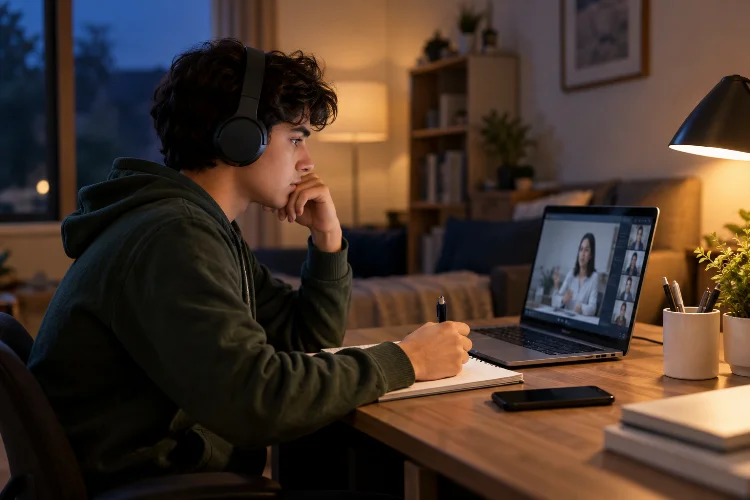
You join an online lecture with every intention of paying attention. Ten minutes later, you have checked a message, opened another browser tab, looked at social media, and somehow started reading something completely unrelated to the lesson.
It happens surprisingly easily.
Online learning gives students flexibility, but it also places the classroom inside the same device used for entertainment, communication, shopping, gaming, and almost everything else. Unlike a physical classroom, there may be nobody sitting nearby to notice when your attention disappears.
That is why staying focused during online classes often requires more deliberate effort than simply opening a laptop and joining a video call.
The good news is that concentration is not only about willpower. Your study environment, technology habits, note-taking methods, routines, and level of participation can all influence how engaged you remain.
With a few practical changes, online classes can become much easier to follow – and you may remember considerably more of what you learn.
1. Create a Study Space That Signals “Class Time”
Your brain quickly associates places with activities.
If you attend lectures while lying in bed, the environment is already strongly connected with sleeping, scrolling, or relaxing. Staying mentally alert can become harder.
You do not need a dedicated home office. Even one consistent corner of a table can become your online learning space.
Before class, clear unnecessary objects, prepare your notebook, get some water, and position your screen comfortably. Small routines like these create a psychological transition between ordinary screen time and academic work.
Your enviroment should also remove obvious temptations whenever possible. If a game controller, television, second device, or unrelated book keeps pulling your attention away, move it temporarily.
The goal is not to create a perfect Instagram-worthy desk. It is to make focused learning the easiest activity available.
2. Remove Digital Distractions Before the Lesson Starts
Online students face a strange problem: the tool they need for learning is also one of their biggest sources of distraction.
Email notifications, messaging apps, social media tabs, breaking news, and random browsing can interrupt attention within seconds.
Research supports taking this problem seriously. One naturalistic study involving 187 university students found that off-task multitasking was associated with poorer memorization of lecture content. Students using laptops also engaged in more multitasking during the lesson.
Another study found that students who multitasked on laptops during lectures performed worse on a later comprehension test than students who did not multitask.
Before class begins, close unrelated tabs and applications. Turn off nonessential notifications and put your phone somewhere you cannot automatically reach it.
You are not trying to prove that you have incredible self-control. You are removing situations where self-control becomes necessary.
3. Stop Treating Online Lectures Like Background Videos
A common mistake is attending class the way you might watch a casual YouTube video.
The lecture plays while you eat, answer messages, organize files, or browse another website. Technically, you are present. Mentally, you may be somewhere else.
Instead, treat an online class as an active learning session.
Listen for the lecturer’s main argument, examples, definitions, and connections between ideas. When something important appears, ask yourself what it means rather than simply typing every word you hear.
If the platform allows questions or discussion, participate occasionally. Even preparing a question can increase attention because you have to monitor whether you actually understand what is being explained.
Active participation turns the lesson from something happening on your screen into something you are actually involved in.
4. Take Notes That Require You to Think
Typing everything a lecturer says can feel productive, but your fingers may be working much harder than your brain.
Instead of trying to create a transcript, write short notes that capture meaning.
Suppose your instructor spends five minutes explaining why inflation can reduce purchasing power. Rather than copying every sentence, you might write:
“Inflation → prices rise → same income buys fewer goods if wages do not keep up.”
Now you have processed the idea and compressed it into your own language.
You can also leave questions in your notes whenever something is unclear. After class, return to those questions and try to answer them from memory or course materials.
Consider keeping notes and entertainment on seperate devices when possible. For example, use your computer for the class but a paper notebook for key ideas.
This reduces the temptation to move between academic and nonacademic tabs every few minutes.
5. Use Short Attention Resets During Long Classes
Nobody maintains identical levels of concentration throughout a long lecture.
Instead of expecting perfect attention for two hours, learn how to notice when your mind has wandered and deliberately bring it back.
During an appropriate break, stand up, stretch, drink water, or look away from the screen for a few minutes. Avoid immediately opening short-form videos or social media, because a five-minute break can easily become fifteen minutes of distraction.
During the lesson itself, use natural transitions as attention resets. When the instructor changes topics, pause mentally and ask, “What was the main idea of that last section?”
This simple question forces you to retrieve what you just heard.
If your class is recorded rather than live, you can create your own study intervals. Watch a manageable section, pause, summarize it without looking at your notes, and then continue.
The best interval is not necessarily the same for everyone. Experiment until you find a rhythm that keeps your concentation strong without constantly interrupting your learning.
6. Set a Clear Goal Before Each Online Class
Focus becomes easier when your brain knows what it is looking for.
Before class starts, spend two minutes checking the topic and deciding what you need to understand.
For example:
“By the end of this lecture, I want to understand the difference between mitosis and meiosis.”
That is much more useful than simply thinking, “I need to survive biology class.”
Goal setting is part of self-regulated learning, an area that appears especially important in online education.
A 2025 meta-analysis examined 42 studies from 37 articles involving 11,014 students and found a significant relationship between self-regulated learning strategies and academic achievement in online and blended settings.
Strategies associated with performance included time management, effort regulation, organization, and metacognitive approaches.
A simple learning goal gives you something specific to monitor while the class is happening.
7. Check Your Understanding Before Leaving the Class
One reason online lessons can feel productive is that everything seems familiar while the teacher is explaining it.
The real question is whether you can remember the information without the teacher.
When class ends, close your notes for two or three minutes.
Ask yourself:
“What were the three main ideas?”
“What can I explain without looking?”
“What still confuses me?”
Write down whatever you remember.
This tiny retrieval activity can reveal the difference between information you recognized and information you actually learned.
Research on self-regulated online learning also suggests that metacognitive regulation and self-evaluation are associated with academic progress.
One study involving 1,163 distance-learning students found that self-evaluation, metacognitive self-regulation, and effort regulation positively predicted academic progress.
That means evaluating your own understanding should be part of the learning process, not something you do only before an exam.
8. Build a Consistent Online Learning Routine
Focus becomes harder when every class begins differently.
One day you join from your desk. The next day you are in bed. Another day you enter the meeting while still searching for your headphones.
A consistent routine reduces these little decisions.
Try joining a few minutes before class, preparing your materials in advance, closing distractions, reviewing the previous lesson briefly, and deciding what you want to learn.
Research reviews of online learning have repeatedly highlighted the importance of self-regulation. A 2023 scoping review examining 163 studies found substantial evidence connecting self-regulated learning with academic achievement in online and blended environments.
An earlier systematic review also identified time management, metacognition, effort regulation, and critical thinking among strategies positively associated with online academic outcomes.
You do not need to feel motivated every day.
A good routine helps you begin even when you do not realy feel like studying.
Staying focused during online classes is not simply a matter of trying harder. Your environment, digital habits, study routine, participation, and learning strategies all shape how much attention you can give to a lesson.
Start by removing obvious distractions and creating a consistent place for class. Take notes actively instead of producing a transcript, set a clear learning goal, and periodically check whether you actually understand the material.
Most importantly, do not expect perfect concentration. Attention will occasionally wander. The useful skill is noticing when it happens and returning to the lesson quickly.
Try one or two of these strategies during your next online class, observe what changes, and gradually build a routine that makes focused learning easier rather than forcing yourself to fight distractions every day.