Walk into two classrooms teaching exactly the same topic and the experience can feel completely different.
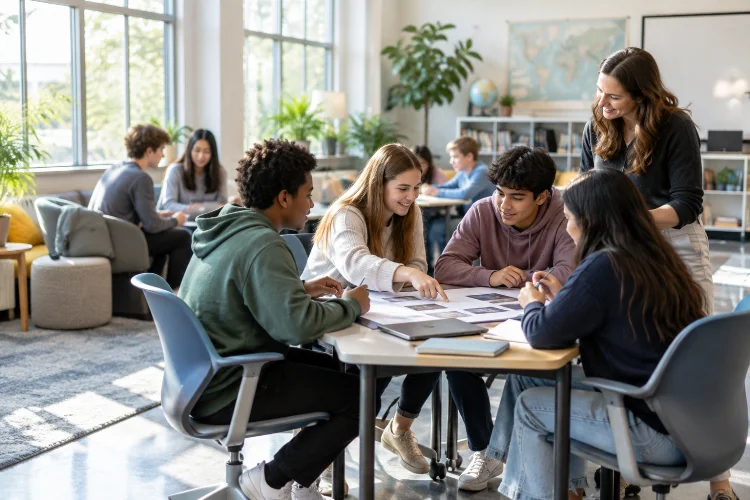
In one room, students sit quietly while the teacher speaks for most of the lesson. In the other, students ask questions, discuss ideas, solve problems, make choices, and explain what they are thinking.
The teacher is still guiding the learning, but students are doing much more of the intellectual work. That second classroom captures an important part of student-centered learning.
Student-centered teaching strategies for more engaging classrooms are not about letting students do whatever they want or removing teachers from the learning process.
They are about designing lessons where learners participate actively, receive useful guidance, and gradually take greater responsibility for their progress.
Research on active learning, collaboration, autonomy, formative assessment, and retrieval practice suggests that involvement matters. The challenge is turning those principles into practical classroom routines without creating chaos or sacrificing academic depth.
Fortunately, student-centered teaching can begin with relatively small changes.
1. Replace Some Teacher Talk With Active Learning
Student-centered classrooms do not require teachers to stop explaining things. Clear explanations still matter.
The difference is that students should regularly have opportunities to do something with what they have just heard.
After explaining a concept for ten minutes, a teacher might give students a question to solve, ask them to compare two examples, predict an outcome, or explain the idea to a partner.
This is active learning.
A major meta-analysis of 225 studies in undergraduate STEM courses found that students in active-learning classes performed better on examinations and concept inventories than students taught mainly through traditional lectures.
Average examination performance improved by about 6%, while students in traditional lecture classes were more likely to fail.
That research focuses specifically on higher-education STEM settings, so it should not be treated as proof that every activity works in every classroom. Still, it strongly supports a basic idea: students often learn more when they actively process course material.
2. Give Students Meaningful Choices
Choice can make students feel more involved in their learning.
That does not mean allowing students to decide whether they want to learn multiplication, grammar, or chemistry. Teachers still need to establish important learning goals.
Instead, give students choices within those goals.
For example, students might choose whether to demonstrate their understanding through a short presentation, written explanation, diagram, or carefully designed project. They might select which example to investigate or choose the order in which they complete several tasks.
Recent research in higher education has also explored how autonomy-supportive policies can influence effort, attendance, and subject mastery.
A 2024 study found that giving university students structured forms of choice could encourage engagement while still directing them toward productive academic behaviour.
The important word is meaningful. Offering ten meaningless options can create confusion, while two or three purposeful choices can give learners genuine ownership.
3. Make Collaborative Learning More Structured
Putting four students around the same table does not automatically create collaboration.
Sometimes one student does all the work while the others watch. In other cases, the conversation moves completely away from the lesson.
Effective collaborative learning needs structure.
Teachers can give students a clear problem, defined roles, a shared outcome, and individual accountability.
In a science lesson, for example, one student might explain the hypothesis, another examine the evidence, another challenge the interpretation, and the final student summarise the group’s conclusion.
The Education Endowment Foundation reports positive average effects for collaborative learning and notes that small groups of around three to five students appear particularly promising.
It also stresses that successful approaches normally require students to talk, interact, and work toward a genuine learning goal.
The purpose of collabortive work is not simply to make lessons more social. Students should be thinking together.
4. Turn Questions Into Conversations
Many classroom questions follow a familiar pattern.
The teacher asks something. One confident student raises a hand. The student answers correctly, and the teacher moves on.
The problem is that this reveals almost nothing about what everyone else understands.
Student-centered questioning should involve more of the room.
A teacher might ask everyone to write an answer before discussion begins. Students could compare responses with a partner, vote between possible explanations, or defend different solutions.
Instead of immediately confirming the correct answer, teachers can also ask follow-up questions such as:
“Why do you think that?”
“What evidence supports your answer?”
“Can anyone explain it differently?”
These questions shift attention from producing the right response to explaining the thinking behind it.
They also give teachers better information about misconceptions, uncertainty, and partial understanding.
5. Use Formative Assessment to Adapt the Lesson
Student-centered teaching becomes much more effective when teachers know what students actually understand.
This is where formative assessment becomes valuable.
Rather than waiting for a major exam, teachers can collect small pieces of evidence during learning. A one-minute written response, mini quiz, exit ticket, discussion prompt, or quick problem can reveal whether students are ready to continue.
The EEF’s Embedding Formative Assessment programme emphasises practices such as clarifying learning intentions, gathering evidence through questions and tasks, encouraging peer support, helping students take ownership, and giving feedback that moves learning forward.
Its evaluation reported a positive average impact on student progress. This makes teaching more responsive.
If half the class misunderstands the same idea, the teacher can adjust immediately instead of discovering the problem two weeks later.
6. Let Students Learn From One Another
Teachers are important sources of knowledge, but they do not need to be the only voices explaining ideas.
Peer explanation can be powerful because students sometimes describe a concept using language or examples that make immediate sense to classmates.
After solving a mathematics problem, for instance, students might compare methods. One learner may use an equation while another uses a diagram.
The discussion then becomes more interesting than simply checking whether both reached the correct answer.
Peer teaching also reveals understanding. Explaining an idea forces students to organise what they know, identify gaps, and respond to questions.
However, teachers still need to monitor accuracy. A student-centered enviroment should not allow misconceptions to circulate without correction.
The teacher’s role changes from being the only speaker to being the person who designs, observes, questions, and redirects the learning process.
7. Build Retrieval and Reflection Into Lessons
Engagement is valuable, but a fun lesson is not automatically a memorable one.
Students also need opportunities to retrieve previous learning.
The Australian Education Research Organisation recommends spacing learning across lessons and asking students to recall information from memory instead of simply rereading it.
Retrieval can strengthen long-term retention and also reveal knowledge gaps that still need attention.
A teacher might begin class with three questions about last week’s topic or ask students to recreate a diagram from memory.
The activity can then become student-centered by asking learners to compare answers, identify what they forgot, and decide what they need to review.
Reflection can work in a similar way.
At the end of a lesson, students might answer: “What makes sense now?” “What is still confusing?” and “What strategy helped me learn today?”
This kind of refelction gradually encourages students to think about their own learning instead of waiting for the teacher to identify every problem.
8. Keep the Teacher’s Guidance Visible
One common misunderstanding is that student-centered teaching means teachers should step aside.
In reality, effective student-centered learning often depends on careful teacher guidance.
Students need clear objectives, useful examples, appropriate challenge, feedback, and boundaries. Giving beginners complete independence before they have enough background knowledge can leave them frustrated rather than empowered.
The goal is gradual responsibility.
A teacher might model a task first, solve another example with the class, let students practise in groups, and finally ask them to work independently.
As students become more confident, the amount of support can decrease.
Student-centered teaching therefore combines autonomy with structure. Students receive more voice and responsibility, but the teacher continues designing the conditions that make successful learning possible.
Student-centered teaching strategies can make classrooms more engaging because students become participants in learning rather than simply receivers of information.
Active learning encourages students to use new ideas, meaningful choise can increase ownership, and structured collaboration gives learners opportunities to think together.
Formative assessment, peer explanation, retrieval practice, and reflection help teachers understand what students know while encouraging learners to monitor their own progress.
You do not need to redesign an entire course overnight.
Choose one lesson this week and identify a moment where students normally listen passively. Replace five or ten minutes of that time with a question, discussion, problem, choice, or retrieval activity. Observe how students respond, adjust the strategy, and build from there.
A more student-centered classroom often begins with one small opportunity for students to think for themselves.