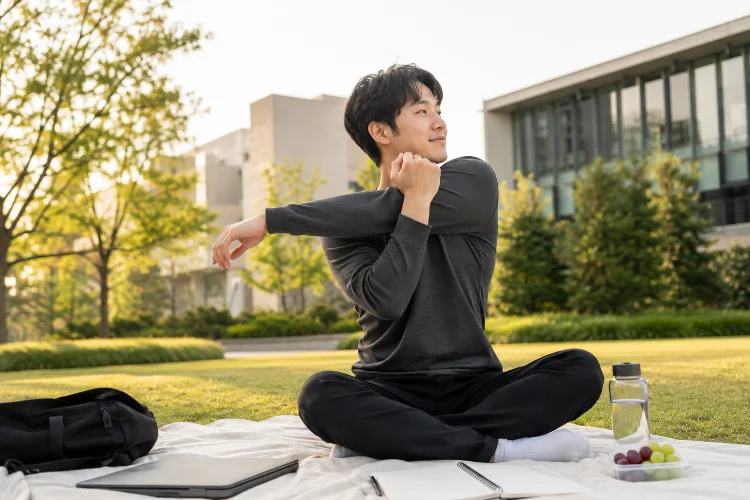
Getting good grades can feel incredibly important. Students may want to enter a competitive university, qualify for scholarships, make their families proud, or simply prove to themselves that they can achieve difficult goals.
The problem begins when academic ambition slowly takes over everything else.
Studying until 2 a.m., skipping meals, avoiding friends, feeling guilty whenever you take a break, and constantly worrying about the next assignment may look like dedication from the outside. In reality, a routine that cannot be sustained is rarely a strong long-term strategy.
Learning how students can balance academic goals with personal wellbeing means recognizing that success and wellbeing do not have to compete.
Sleep, movement, supportive relationships, reasonable boundaries, and time away from schoolwork can all help students maintain the energy required to keep learning.
The World Health Organization emphasizes that adolescent wellbeing involves healthy relationships, confidence, supportive environments, and opportunities to realize one’s potential.
The goal is not to study less simply for the sake of it. It is to build an academic life you can actually maintain.
Stop Treating Busyness as Academic Success
A busy schedule can create the feeling that you are achieving something.
But being busy and being productive are not the same.
A student might spend six hours at a desk while constantly switching between social media, assignments, messages, videos, and notes. Another student may complete focused work in three hours and have the evening available for other activities.
The second student is not necessarily less committed.
Instead of measuring academic effort only by hours, focus on results.
Ask yourself:
What did I actually complete?
What did I understand better?
Which difficult task moved forward?
Did today’s work support one of my important goals?
A successful study routine should create progress, not simply exhaustion.
Set Goals That Fit Into a Real Life
Students often create academic goals without considering everything else they need to do.
They may plan five hours of studying after a full school day, sports practice, commuting, family responsibilities, and dinner.
The plan looks impressive on paper.
It is also unrealistic.
Start by identifying the academic goals that matter most.
Maybe you need to improve mathematics, finish a research project, and prepare for an upcoming exam.
Then estimate how much time those priorities genuinely require.
Instead of planning:
“Study everything tonight,”
try:
“Complete 15 calculus problems from 7:00 to 8:00, take a break, then review biology flashcards for 30 minutes.”
Smaller and more specific goals make progress easier to manage.
A realistic schedule may not look as ambitious, but it is much easier to follow consistantly.
Protect Sleep Like an Academic Resource
Sleep is often the first thing students sacrifice when deadlines increase.
An extra two hours at night can feel like free study time.
It is not necessarily free.
The CDC notes that sufficient sleep supports students’ health, focus, concentration, and academic performance. It also reports that inadequate sleep is associated with attention and behavior problems that can interfere with learning.
Students therefore need to treat sleep as part of their academic routine rather than something that happens only after every assignment is finished.
If you regularly need to stay awake extremely late, look at the system behind the problem.
Are you starting assignments too late?
Are you spending too much study time distracted?
Are you accepting too many commitments?
Are your daily goals unrealistic?
Occasional late nights happen.
But if sleep deprivation becomes your normal productivity strategy, something else probably needs to change.
Build Clear Boundaries Around Study Time
Studying can expand until it occupies every available minute if you never decide when to stop.
Try giving schoolwork clear boundaries.
For example, you might decide that weekdays from 7:00 to 9:00 p.m. are focused study periods, while the final hour before sleep is reserved for relaxing and preparing for the next day.
Boundaries can actually increase concentration.
When you know you have only 60 minutes for an assignment, you may be less likely to spend 20 minutes checking unrelated websites.
A defined stopping point also makes breaks more enjoyable.
Without boundaries, students often feel guilty while resting because they believe they could be studying.
That creates the worst combination: not really studying and not really resting.
When study time ends, allow it to end.
Use Breaks Before You Become Completely Exhausted
Students sometimes think breaks should be earned only after finishing everything.
But academic work is rarely completely finished.
There will always be another chapter, assignment, quiz, or reading.
Short breaks can make long study sessions easier to sustain.
After a concentrated period of work, stand up and move around.
Drink water.
Step outside.
Talk with someone.
Do something that does not require staring at another academic screen.
Breaks do not have to follow one perfect formula.
Some students prefer 25-minute focus sessions. Others work well for 45 or 60 minutes.
The important point is recognizing when concentration is fading.
Three hours of tired rereading may produce less learning than two focused sessions with recovery between them.
Rest is not the opposite of productivity.
Used deliberately, it supports it.
Keep Physical Activity in Your Schedule
Busy academic periods often make exercise disappear.
Students may think they need to choose between studying and being physically active.
That is an unnecessary trade-off.
WHO guidance notes that regular physical activity supports physical health, mental wellbeing, cognitive outcomes, and learning.
For children and adolescents, WHO recommends an average of at least 60 minutes of moderate-to-vigorous physical activity per day across the week.
Physical activity does not have to mean joining a competitive sports team.
Walking, cycling, dancing, swimming, playing games, doing a workout, or simply moving more throughout the day can all contribute.
The CDC has also found an association between greater physical activity and higher academic grades among U.S. high-school students, although the data do not prove that exercise directly causes higher grades.
Think of movement as part of a balanced student routine rather than time stolen from studying.
Make Space for Friends, Family, and Life Outside School
Academic goals matter, but students are not academic machines.
Relationships matter too.
Talking with friends, spending time with family, participating in hobbies, and simply being around people you care about can provide a valuable break from performance pressure.
WHO’s adolescent wellbeing framework highlights supportive relationships and social environments as important parts of healthy development.
You do not need a large social circle.
The important thing is having people you can communicate with honestly.
Academic challenges also become easier to manage when students ask for support early.
If you are confused about an assignment, contact the teacher.
If your workload feels unmanageable, discuss priorities with someone you trust.
Trying to handle every difficulty alone is not proof of independence.
Sometimes good self-management means knowing when additional support is useful.
Learn to Recognize Unsustainable Stress
Stress is not always bad.
A deadline can encourage action.
A challenging exam can motivate students to prepare.
But there is a difference between temporary academic pressure and feeling overwhelmed for long periods.
A systematic review of post-secondary students found that stress affecting academic success involves a complex combination of academic, behavioral, psychological, social, and other factors rather than one simple cause.
Students should pay attention when stress begins consistently interfering with concentration, sleep, daily responsibilities, relationships, or their ability to function normally.
WHO notes that healthy sleep, regular exercise, coping skills, supportive relationships, and safe environments are among the factors that support adolescent mental wellbeing.
If stress becomes persistent or difficult to manage, talking with a trusted adult, school counselor, healthcare professional, or another appropriate support service can be useful.
Academic goals are important, but no grade should require ignoring serious problems with wellbeing.
Stop Comparing Your Schedule With Everyone Else
Comparison can destroy a perfectly reasonable routine.
You study two hours and discover that a classmate claims to study six.
Suddenly your effort feels inadequate.
But you usually do not know the full situation.
Maybe they have different subjects.
Perhaps they work less efficiently.
Maybe their schedule is genuinely unsustainable.
Or perhaps they simply need more study time for that particular course.
Academic routines should reflect your responsibilities, learning needs, energy, and goals.
The better comparison is with your previous performance.
Are your study habits improving?
Are you procrastinating less?
Can you understand material more quickly?
Are you sleeping more regularly?
Are assignments being completed before the deadline?
Progress does not need to look identical for every student.
Plan Recovery After Intense Academic Periods
Some periods genuinely require extra effort.
Final exams, major projects, university applications, or important competitions can temporarily make life busier.
Balance does not mean every day must contain equal amounts of work and relaxation.
Sometimes a week will be academically intense.
The key is making that intensity temporary.
After an important exam, allow some recovery.
Sleep normally.
Spend time outside.
Return to hobbies.
Reconnect with people you have seen less often.
A schedule that occasionally becomes demanding is very different from one that remains demanding for months without recovery.
Think in Weeks, Not Perfect Days
One day may contain mostly studying.
Another may include sports, friends, or family activities.
That does not automatically mean your life is unbalanced.
Look at the broader pattern.
Over a normal week, are you making progress academically while still sleeping, moving, connecting with people, and having some personal time?
That is usually a more useful measure than trying to create one perfectly balanced day.
Create a Sustainable Definition of Success
Students often define academic success entirely through numbers.
Grades matter, especially when they affect university admission or future opportunities.
But they are not the only useful measure.
A succesful student may also be someone who can manage deadlines, ask for help, study independently, work with other people, recover from setbacks, maintain relationships, and continue learning without constantly feeling overwhelmed.
Those skills matter far beyond school.
Try asking yourself:
“If I achieve my grades but hate every day of the process, is my system working?”
Sometimes the answer will reveal that the goal is fine but the method needs changing.
You do not need to abandon ambition.
You need a version of ambition that leaves enough energy to continue pursuing it.
Review Your Balance Regularly
A routine that worked last month may stop working when your workload changes.
Review your schedule every week or two.
Look at what happened honestly.
Did you finish important work?
Did you sleep enough?
Did procrastination create unnecessary stress?
Did you have any time away from academic tasks?
Which commitment could be reduced?
Which subject needs more attention next week?
Then adjust.
Personal wellbeing is not something you “finish” organizing once.
Neither is academic planning.
Both require ongoing decisions.
A strong routine changes as your workload, responsibilities, and priorities change.
The goal is not perfection.
It is making small corrections before an overloaded schedule becomes an unsustainable one.
Balancing academic goals with personal wellbeing does not mean choosing between success and a healthy life.
In many cases, sustainable academic performance depends on maintaining enough energy, concentration, sleep, movement, recovery, and social support to keep working effectively over time.
Set realistic goals, protect clear study boundaries, take meaningful breaks, maintain physical activity, and avoid sacrificing sleep whenever your workload increases. Pay attention to prolonged stress and adjust your schedule when the system stops working.
Start with one practical change this week. Choose a regular stopping time for schoolwork, protect your sleep schedule, or remove one commitment that no longer deserves your time.
Strong students do not simply learn how to work harder. They learn how to build routines they can keep using for the long term.