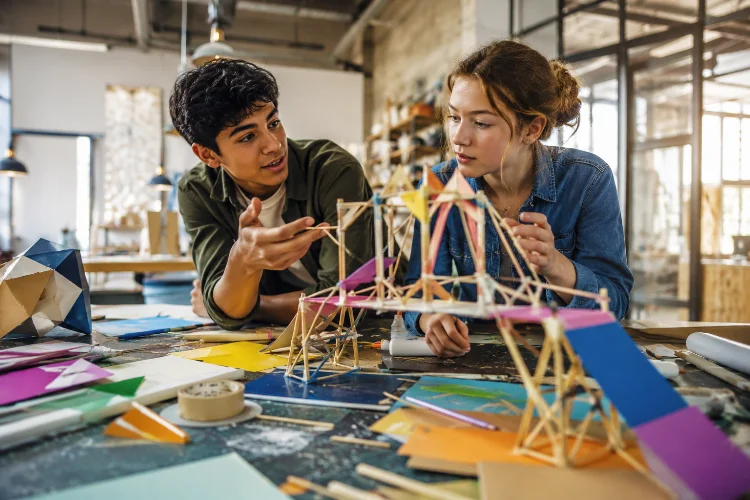
Some school problems are easy because there is a clear formula, rule, or correct answer. Others are much more frustrating. Students may understand the basic information but still have no idea how to move forward.
That is where creative thinking becomes valuable.
Learning how creative thinking can help students solve difficult problems is not about becoming an artist or constantly inventing completely original ideas.
In education, creativity often means looking at a challenge from several angles, generating different possibilities, combining existing knowledge in new ways, and improving ideas until a workable solution appears.
The OECD defines creative thinking as the ability to generate, evaluate, and improve diverse and original ideas. Its PISA 2022 assessment applied those skills not only to creative expression but also to social and scientific problem solving.
Students who develop this habit become less dependent on finding one familiar method. When the first solution fails, they have another question to ask: What else could work?
Creative Thinking Is Not Just About Having Wild Ideas
Creativity is sometimes treated as something people either naturally have or do not have.
In reality, everyday creative thinking can be practised.
A creative student does not necessarily produce unusual ideas every minute. Instead, they become more willing to explore possibilities before settling on an answer.
The OECD’s creative-thinking framework focuses on three important processes: generating diverse ideas, generating original ideas, and evaluating or improving ideas.
Imagine students are asked to reduce food waste at school.
One student immediately suggests putting up posters.
A creative-thinking approach would continue:
Could the cafeteria change portion sizes?
Could students pre-select meals?
Could leftover ingredients be reused safely?
Could waste data be tracked by day?
The first answer may still be good. The difference is that students do not stop there.
Generate Several Solutions Before Choosing One
Difficult problems often become easier when students temporarily stop searching for the correct answer.
Instead, generate several possible answers.
This process is often called divergent thinking.
Suppose a student needs to design a bridge using limited materials.
Instead of building the first design that comes to mind, they could sketch five possibilities.
One design might use triangles.
Another could use arches.
A third might reduce the bridge’s length.
Only after generating several options does the student compare them.
OECD PISA data show that creative-thinking assessment specifically includes tasks requiring students to produce multiple distinct responses rather than only one conventional answer.
This approach prevents students from becoming emotionally attached to their first idea.
Sometimes the third or fourth solution is much stronger than the first.
Reframe the Problem Before Trying to Solve It
Sometimes students struggle because they are solving the wrong version of the problem.
Reframing means describing the challenge differently.
Imagine a group project where meetings constantly fail because nobody can find a convenient time.
The obvious problem might be:
“How do we find a time when everyone can meet?”
A better question could be:
“How can we complete the project without needing everyone online simultaneously?”
That small change creates new possibilities.
Students might use shared documents, recorded updates, asynchronous discussions, or smaller team meetings.
When stuck, try asking:
What is the real problem here?
Or:
Could I describe this challenge in a different way?
Changing the question can sometimes be more powerful than immediately searching for another answer.
Connect Ideas From Different Subjects
Creative solutions often come from combining things that were previously seperate.
School subjects can make knowledge look neatly divided.
Mathematics belongs in one classroom.
Science belongs in another.
Art, history, technology, and economics each have their own lessons.
Real-world problems rarely behave that way.
Suppose students are asked to design a more sustainable school building.
Science helps them understand energy.
Mathematics helps calculate costs and dimensions.
Geography influences climate considerations.
Design affects usability.
Economics determines whether the proposal is financially realistic.
Research on classroom creativity suggests that students benefit when creative thinking is taught alongside subject knowledge, allowing them to apply what they know in new ways rather than treating creativity as an isolated skill.
Try asking:
“What do I already know from another topic that might help here?”
Unexpected connections often produce useful ideas.
Treat Failure as Information
Creative problem solving involves experimentation.
That means some ideas will fail.
Students sometimes interpret failure as evidence that they are bad at the subject.
A more productive response is:
“What did this attempt teach me?”
Imagine a science experiment produces an unexpected result.
Instead of immediately throwing it away, investigate why.
Was the original assumption wrong?
Was one variable uncontrolled?
Did the equipment behave differently?
Could the unusual result reveal something interesting?
Harvard Project Zero highlights experimentation, risk-taking, and open-ended investigation as ways to create learning environments where students can explore ideas and work through frustration.
A failed attempt is not automatically wasted effort.
It can eliminate one possibility and make the next attempt smarter.
Use “What If?” Questions to Break Familiar Thinking
One of the easiest creative-thinking exercises requires only two words:
What if?
Imagine studying city transportation.
Ask:
What if private cars were banned from the city center?
What if buses were free?
What if every school started at a different time?
What if roads could be redesigned from scratch?
Some ideas may be unrealistic.
That is fine during the early stage.
The purpose is to temporarily remove assumptions that limit thinking.
After generating possibilities, students can return to reality and evaluate which ideas are practical.
This separates idea generation from idea evaluation.
Trying to do both simultaneously can shut creativity down too early.
If every new idea is immediately met with “that won’t work,” students may eventually stop suggesting anything unusual.
Solve More Open-Ended Problems
Many traditional school questions have one correct answer.
Students need those questions because foundational knowledge matters.
But they also need problems where several reasonable solutions are possible.
A meta-analysis of 19 studies and 77 effect sizes found that problem-solving pedagogy had a moderately positive overall effect on creativity. The study also found that problems students helped discover themselves were particularly supportive of creative engagement.
An open-ended mathematics problem might ask students to design two different ways to reduce a household budget by 15%.
A science task could ask how a community might reduce water consumption.
A literature lesson might ask students to create several plausible interpretations of a character’s decision.
These problems force students to make choices.
That is where deeper thinking begins.
Collaborate With People Who Think Differently
Sometimes the fastest way to escape your own thinking pattern is to hear someone else’s idea.
One student may notice a practical problem.
Another sees a technological solution.
Someone else identifies a social consequence nobody considered.
Collaboration gives students access to a larger pool of perspectives.
A recent systematic review of collaborative problem solving found that open-ended problems can support reflective discussion and higher-order thinking, while the quality of communication plays an important role in successful collaboration.
This is why disagreement can sometimes be useful.
Instead of trying to prove that your idea is best, ask:
“What does the other person’s approach notice that mine misses?”
A succesful group does not need everyone to think identically.
Different perspectives can become a resource.
Improve Existing Ideas Instead of Always Starting From Zero
Creativity does not always mean inventing something completely new.
Often, the smarter approach is improving something that already exists.
Look at a current solution and ask:
What works?
What does not?
What could be faster?
What could be cheaper?
What could be easier to use?
What could be more inclusive?
Suppose your school already has a recycling system, but students rarely use it correctly.
Instead of creating an entirely new environmental program, students could redesign labels, change bin locations, simplify categories, or collect data about where mistakes occur.
Improvement is a major part of creative thinking.
The OECD framework explicitly includes evaluating and improving ideas alongside generating original ones.
An idea does not need to be revolutionary to be creative.
It simply needs to make something better in a meaningful way.
Give Your Brain Time to Explore
Students often feel pressure to solve difficult problems immediately.
But creative thinking does not always happen on command.
Sometimes you need time away from the problem.
After working intensely, take a short walk.
Switch to another task.
Write your ideas down and return later.
You may notice a connection you missed earlier.
However, taking a break is different from avoiding the task indefinately.
Do enough initial work that your brain has something to process.
Understand the problem, gather information, and attempt several solutions first.
Then step away briefly.
Creative thinking usually needs both focused effort and enough mental space for alternatives to appear.
Use Technology as a Creative Partner, Not an Answer Machine
Digital tools can expand the number of possibilities students explore.
Simulations can test different scientific conditions.
Design software allows rapid prototypes.
Spreadsheets make comparing scenarios easier.
Generative AI can help brainstorm alternatives.
But technology should not replace the thinking process.
A 2026 systematic review of 67 empirical studies on ChatGPT in higher education found that generative AI could support creative and critical thinking when used within scaffolded, inquiry-oriented learning designs.
A useful approach is to create your own ideas first.
Then use technology to challenge them.
You could ask AI:
“What weaknesses might exist in these three solutions?”
Then evaluate whether the feedback is reasonable.
Technology becomes most valuable when it expands your thinking rather than doing all the thinking for you.
Creative Thinking Can Be Developed at School
Creativity should not be limited to art class.
Students can practise it in mathematics, science, languages, history, technology, social studies, and everyday school projects.
PISA 2022 assessed creative thinking across written expression, visual expression, social problem solving, and scientific problem solving, showing how broadly the skill can be applied.
The results also show that creative thinking deserves deliberate attention. Across OECD countries, about half of students reached a level where they could generate original and diverse ideas in relatively simple imagination or everyday problem-solving tasks.
Students should therefore receive regular opportunities to ask questions, generate alternatives, experiment, collaborate, and improve ideas.
Creativity becomes stronger when it is practised consistantly rather than reserved for occasional special projects.
Creative thinking helps students deal with difficult problems because it gives them more options when familiar methods are not enough.
Instead of immediately searching for one correct answer, students can generate alternatives, reframe the challenge, connect knowledge from different subjects, experiment with ideas, collaborate with others, and improve existing solutions.
Failure also becomes more useful because every unsuccessful attempt can provide information for the next one.
Students can begin developing this skill with a simple habit. The next time a difficult school problem seems impossible, resist the urge to stop after your first solution. Write down at least three different possibilities-even if one sounds unrealistic.
Then compare them, combine their strongest parts, and test the best option. The ability to keep exploring when the obvious answer fails is one of the most practical forms of creativity students can develop.