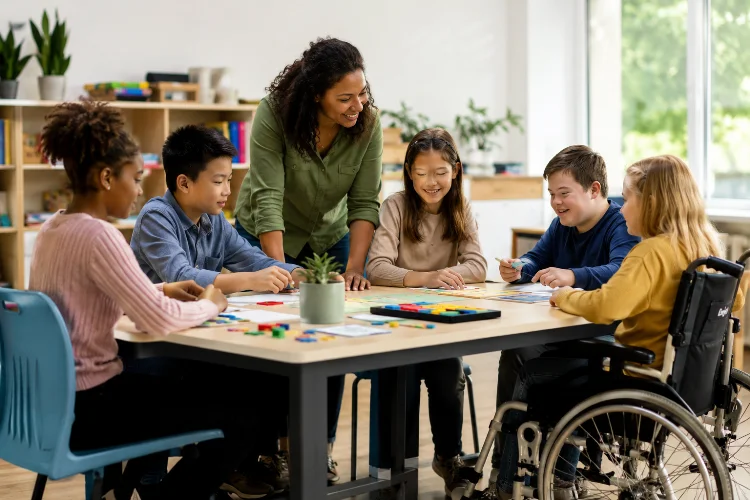
Imagine walking into a classroom where every student is expected to learn in exactly the same way, at exactly the same speed, using exactly the same materials.
For some students, that approach may work perfectly. For others, it can create barriers before meaningful learning even begins.
Students arrive at school with different abilities, languages, cultures, family circumstances, learning preferences, experiences, and support needs.
A strong education system recognizes those differences instead of expecting every learner to fit into one narrow model.
That is the basic idea behind understanding inclusive education and why it matters in schools. Inclusive education aims to create learning environments where students can participate, belong, and receive meaningful opportunities to succeed alongside their peers.
UNESCO describes inclusion as identifying and removing barriers to education so that learner differences in identity, background, language, economic circumstances, or ability do not become reasons for exclusion.
Inclusion is therefore much bigger than simply placing different students in the same classroom. It requires schools to rethink how teaching, support, assessment, accessibility, and school culture work.
What Does Inclusive Education Actually Mean?
Inclusive education means creating schools that are designed to serve diverse learners rather than expecting learners to adapt to systems that were not designed for them.
UNICEF describes inclusive education as providing opportunities for children from different backgrounds to learn together in the same classrooms and schools.
This includes children with disabilities as well as students who have traditionally faced exclusion for other reasons.
Importantly, inclusion is not simply physical placement.
A student can technically be present in a mainstream classroom while still being excluded from meaningful participation.
For example, imagine a student with a hearing impairment who attends every lesson but cannot clearly hear classroom discussions.
The student is physically included but may not have equal access to learning.
True inclusion asks a deeper question:
Can every student meaningfully participate in what is happening?
That may require accessible materials, assistive technology, adapted activities, additional teacher support, flexible assessment, or changes to the physical classroom.
Inclusive Education Is About More Than Disability
Inclusive education is often discussed mainly in relation to students with disabilities.
Disability inclusion is extremely important, but the concept is broader.
UNESCO’s Global Education Monitoring Report emphasizes that exclusion can be connected to factors such as poverty, gender, disability, ethnicity, language, migration status, location, and other aspects of a learner’s background.
Consider a student who recently moved to a new country and does not yet speak the classroom language fluently.
Another student may come from a low-income household without reliable internet access at home.
Someone else may have dyslexia, while another learner understands the content easily but needs greater academic challenge.
All of these students may face different barriers.
An inclusive school does not assume that fairness means giving everybody exactly the same thing.
Sometimes fairness means providing different forms of support so students can work toward meaningful learning goals.
Why Inclusive Education Matters for Students
One of the biggest benefits of inclusion is simple: students have greater opportunities to participate in education with their peers.
UNICEF estimates that around 240 million children worldwide live with disabilities and notes that these children remain among those most likely to be excluded from school.
Exclusion can affect much more than academic achievement.
School is also where children develop friendships, communication skills, independence, confidence, and a sense of belonging.
When students are unnecessarily separated from their peers, they can lose access to some of those experiences.
Inclusive schools attempt to remove barriers before those barriers become reasons for exclusion.
This does not mean pretending every learner needs the same support.
It means recognizing differences while maintaining the expectation that every student deserves meaningful participation in education.
Inclusion Can Benefit the Whole Classroom
Inclusive teaching practices are often introduced to support students with specific learning needs, but many of those strategies can benefit everyone.
Imagine a teacher who provides verbal instructions and also displays them visually.
A student with language-processing difficulties may find the written instructions essential.
But other students also benefit because they can check what they are supposed to do without repeatedly asking the teacher.
The same applies to clearly structured lessons, visual examples, captions, flexible ways to demonstrate learning, and breaking complex tasks into manageable stages.
Inclusive teaching often encourages teachers to explain ideas in multiple ways.
That can improve clarity throughout the entire classroom.
The goal is not to create dozens of completely seperate lessons.
Instead, teachers can design learning experiences that are flexible enough to accommodate a wider range of students from the beginning.
Build a Strong Sense of Belonging
Students need more than access to a school building.
They need to feel that they belong there.
A student who is constantly treated as a problem, separated unnecessarily, ignored during group activities, or made to feel different may technically attend an inclusive school without experiencing genuine inclusion.
School culture therefore matters.
Teachers can encourage belonging by using respectful language, challenging stereotypes, creating mixed collaborative activities, and making sure different students have opportunities to contribute.
Classrooms should communicate a simple message:
You are part of this learning community.
UNESCO’s inclusion framework emphasizes seeing learner diversity as a strength rather than treating differences as problems that need to disappear.
That shift in mindset can change how teachers interpret student differences.
Instead of asking, “What is wrong with this learner?” educators can ask, “What barrier is preventing this learner from participating?”
That is a much more useful question.
Use Flexible Teaching Without Lowering Expectations
Inclusive education does not mean making learning easier for everyone.
It means making learning more accessible.
There is an important difference.
Suppose students are learning about the water cycle.
One student might understand the concept through a textbook explanation.
Another may benefit from a diagram.
Someone else might need the teacher to demonstrate the process visually before reading about it.
The learning objective can remain the same even when the pathway toward it changes.
Teachers can also allow students to demonstrate understanding in different appropriate ways when the assessment goal permits it.
For example, students might explain a concept through writing, an oral presentation, a diagram, or a structured project.
The important thing is that the chosen method still measures the intended learning.
Inclusive education should maintain meaningful academic expectations while providing the accomodation and support needed to help students work toward them.
Teachers Need Training and Practical Support
Inclusive classrooms cannot depend entirely on individual teachers improvising solutions.
Teachers need knowledge, resources, planning time, specialist support, and professional development.
UNESCO reports that around 40% of countries do not provide teacher training on inclusion, highlighting a major challenge for education systems attempting to become more inclusive.
A teacher may genuinely want to support every student but still struggle when managing a large class with several different learning needs.
Schools therefore need systems of support.
General classroom teachers may work with special education professionals, counselors, language specialists, teaching assistants, psychologists, families, and school leaders.
Evidence reviewed by the Education Endowment Foundation also highlights the importance of strong classroom teaching alongside additional targeted support for pupils with special educational needs and disabilities.
Inclusion works better when responsibility is shared rather than placed on one teacher.
Accessibility Should Be Built Into the School Environment
Sometimes barriers have little to do with the lesson itself.
Consider a student using a wheelchair in a school where the science laboratory can only be reached by stairs.
The teaching may be excellent, but the physical enviroment creates exclusion.
Accessibility can involve ramps, elevators, suitable toilets, accessible desks, classroom acoustics, lighting, digital materials, captions, screen-reader compatibility, or assistive technology.
UNICEF emphasizes that inclusive systems require changes beyond classroom instruction, including accessible learning materials, teacher preparation, and improvements to school environments.
Digital accessibility matters too.
A PDF that cannot be read by accessibility software may prevent a student from completing the same task as classmates.
Building accessibility into materials from the beginning is usually easier than trying to fix barriers after a student encounters them.
Families Should Be Partners in Inclusion
Families often understand a student’s strengths, challenges, communication needs, and previous experiences better than anyone else.
Schools can learn from that knowledge.
Instead of contacting families only when something goes wrong, teachers can build communication early.
Ask what helps the student learn.
Find out what situations create difficulty.
Discuss strategies that work at home or in previous classrooms.
This does not mean families should be responsible for designing the school’s educational response.
It means their perspective should be taken seriously.
Inclusive education becomes stronger when teachers, families, specialists, and students themselves contribute to decisions about learning and support.
Older students in particular should be encouraged to communicate what helps them succeed.
Learning to advocate for their own needs can become an important life skill.
Inclusion Requires a Whole-School Approach
One inclusive teacher cannot create an inclusive education system alone.
School leadership, policies, physical infrastructure, curriculum, assessment, teacher development, student support, and community attitudes all matter.
A 2026 UNICEF Innocenti report examining education systems across several countries concluded that exclusion is not inevitable.
Education systems can improve participation for children with disabilities and learning differences when they consistently recognize learner needs, reform systems, and provide resources for inclusion.
Schools can begin by examining where barriers exist.
Who participates fully?
Who regularly misses learning opportunities?
Which students are disproportionately disciplined, absent, separated, or struggling?
Are teaching materials accessible?
Do teachers have enough support?
Do students feel safe asking for help?
These questions move inclusion from a slogan to a practical process.
Progress may happen gradually.
What matters is that schools examine barriers consistantly and keep improving the conditions in which students learn.
Inclusive Education Prepares Students for a Diverse World
Schools are not isolated from society.
Students will eventually study, work, communicate, and live alongside people with different abilities, cultures, languages, experiences, and perspectives.
An inclusive classroom provides opportunities to experience that diversity early.
Students learn that people may communicate differently, solve problems differently, require different support, and still contribute meaningfully to a community.
This can encourage empathy, cooperation, adaptability, and respect.
Inclusive education is therefore not only about helping students who are at greater risk of exclusion.
It is also about creating schools that better reflect the diverse societies students will eventually participate in.
When diversity becomes a normal part of classroom life, differences do not automatically need to become divisions.
Inclusive education is not simply about placing every student inside the same classroom.
It is about creating conditions where learners with different abilities, backgrounds, languages, circumstances, and support needs can participate, learn, and feel that they belong.
Achieving that goal requires accessible environments, flexible teaching, clear expectations, trained educators, family collaboration, appropriate support, and a school culture that sees diversity as valuable rather than inconvenient.
Schools do not need to solve every inclusion challenge immediately. They can begin by identifying one barrier that makes learning harder for some students and asking how it could be removed.
Start with accessibility, classroom participation, teaching materials, or student feedback. Every improvement can help create a school where more learners have a genuine opportunity to succeed.